
Thread Milling vs. Tapping - Key Differences Explained
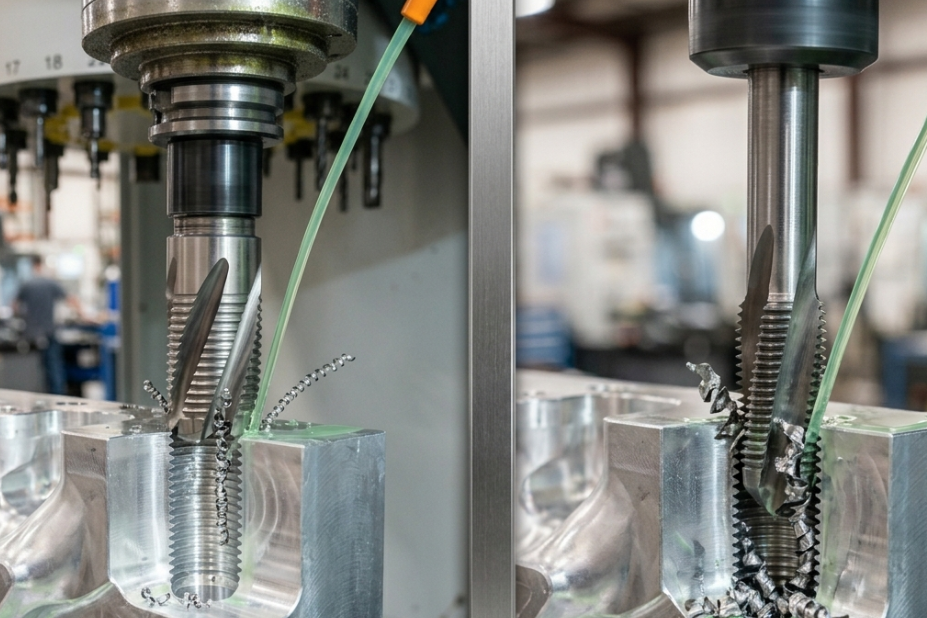
Two of the most common threading methods are thread milling and tapping. While both create threaded holes, they differ significantly in tooling, machine movement, achievable tolerances, and material compatibility.
Understanding the strengths and limitations of each method helps manufacturers improve efficiency, reduce tooling costs, and achieve better-quality threads. For businesses across Brisbane, the Gold Coast, and the Sunshine Coast, choosing the right threading process can lead to considerable production advantages.
What Is Thread Milling in CNC Machining?
This is a CNC machining process that forms threads with a rotating cutting tool following a programmed helical path. Instead of cutting the entire thread profile at once, the cutter gradually removes material while moving in circular interpolation around the hole.
How Thread Milling Works
The process involves:
- Drilling a pilot hole.
- Position the thread mill inside the hole.
- Moving the cutter in a circular path.
- Simultaneously moving upward or downward to create the thread pitch.
- Completing the full thread profile through controlled tool movement.
Features of Thread Milling
- CNC-controlled threading process
- Suitable for internal and external threads
- One tool can often create multiple thread sizes
- Excellent control over thread dimensions
- Lower risk of catastrophic tool failure
What Is the CNC Tapping Process?
How Tapping Works
- Drill the hole.
- Align the tap.
- Rotate the tap into the material.
- Cut threads in a single operation.
- Reverse the tap out of the hole.
Types of Taps
- Hand taps
- Spiral point taps
- Spiral flute taps
- Form taps
- Machine taps
Tapping is widely used because it is simple, fast, and effective for many common materials.
How Does Thread Milling Differ from Tapping?
| Feature | Thread Milling | Tapping |
| Thread Creation | Helical cutting path | Single-pass cutting |
| Tool Flexibility | One tool for multiple sizes | One tap per thread size |
| Tool Breakage Risk | Low | Higher |
| Hard Materials | Excellent | More challenging |
| Thread Adjustment | Easy | Limited |
| Large Diameter Threads | Excellent | Less practical |
| Setup Complexity | Higher | Lower |
| Production Speed | Moderate | Fast |
Why Are Manufacturers Increasingly Using Thread Milling?
According to Sandvik Coromant, thread milling can significantly reduce tooling inventory because a single cutter can often produce multiple thread diameters of the same pitch.
Additionally, modern CNC machines increasingly support advanced thread milling cycles, making the process more accessible than ever.
Thread Milling vs Tapping Accuracy Comparison
Accuracy is often a deciding factor when choosing between these processes.
Thread Milling Accuracy Advantages
Thread milling provides:
- Better pitch diameter control
- Easier compensation for tool wear
- Improved thread consistency
- Greater repeatability
- Ability to fine-tune thread dimensions
Tapping Accuracy Limitations
- Tap condition
- Material consistency
- Machine rigidity
- Proper alignment
Once a tap wears, thread quality may decline until the tool is replaced.
Which Produces Better Threads?
For high-precision applications, thread milling generally provides superior dimensional control and repeatability.
When Should You Use Thread Milling Over Tapping?
Use Thread Milling When:- Thread milling reduces the risk of scrap caused by broken taps.
- Large threads become easier and more economical to machine.
- Industries such as aerospace and medical manufacturing often require tighter tolerances.
- One thread mill can often create several diameters with the same pitch.
- Thread milling provides better chip evacuation.
Why Is Thread Milling Preferred for Hard Materials?
Thread Milling for Hard Materials
Hard materials create higher cutting forces during tapping.
Examples include:
- Hardened steel
- Stainless steel
- Titanium
- Tool steel
- High-strength alloys
Challenges With Tapping Hard Materials
Tapping can lead to:
- Tap breakage
- Increased tool wear
- Poor thread quality
- Difficult chip evacuation
Advantages of Thread Milling
Thread milling removes smaller amounts of material per pass.
Benefits include:
- Lower cutting pressure
- Reduced heat generation
- Longer tool life
- Improved thread consistency
This makes thread milling especially valuable in demanding industrial applications.
What are the Different Thread Milling Tool Types?
Single-Point Thread Mills
These cutters machine one thread profile at a time.
Advantages:
- Maximum flexibility
- Multiple diameter capability
- Excellent precision
Multi-Form Thread Mills
These tools contain several thread forms.
Advantages:
- Faster machining
- Higher productivity
- Suitable for larger production runs
Solid Carbide Thread Mills
Popular because they offer:
- High rigidity
- Excellent wear resistance
- Long tool life
Indexable Thread Mills
These use replaceable inserts.
Advantages:
- Lower tooling costs
- Easy maintenance
- Ideal for large-scale production
How Do Thread Milling Tolerances Compare with Tapping Tolerances?
Thread Milling Tolerances
Thread milling allows:
- Fine dimensional adjustments
- Compensation for tool wear
- Consistent pitch diameter control
Typical achievable tolerances are often tighter because CNC programs can be adjusted without changing tools.
Tapping Tolerances
Tapping typically relies on:
- Tool manufacturing precision
- Hole preparation quality
- Material characteristics
For critical engineering applications, thread milling generally provides superior tolerance management.
Can a CNC Router Do Thread Milling?
Yes, it is possible if certain conditions are met.
Requirements
A CNC router typically needs:
- Interpolation capability
- Sufficient spindle control
- Appropriate CAM software
- Suitable thread milling cutter
Common Applications
CNC routers may perform thread milling in:
- Plastics
- MDF
- Composite materials
- Aluminium
- Wood-based products
For heavy-duty metal threading, machining centres generally provide better performance.
What Feeds and Speeds Are Used for Thread Milling?
Feeds and speeds depend on:
- Material type
- Tool diameter
- Thread size
- Coating type
- Machine rigidity
Example Factors
Aluminium
Typically allows:
- Higher spindle speeds
- Faster feed rates
Stainless Steel
Usually requires:
- Lower speeds
- More conservative feed rates
Titanium
Often requires:
- Reduced cutting speeds
- Careful heat management
Why Optimisation Matters
Correct feeds and speeds help:
- Improve thread quality
- Extend tool life
- Reduce cycle times
- Prevent tool failure
Manufacturers should follow tooling supplier recommendations and conduct test cuts when necessary.
Thread Milling Cost vs Tapping Cost
Initial Tooling Cost
Taps are usually less expensive to purchase. Thread mills generally cost more upfront.
Long-Term Production Cost
Thread milling can reduce costs through:
- Longer tool life
- Fewer broken tools
- Lower scrap rates
- Greater versatility
Tool Inventory Savings
A single thread mill may replace several taps. This can lower inventory requirements and simplify production management.
Which is more cost-effective?
For high-volume, simple threading, tapping often remains the economical choice. For precision work, hard materials, and varied thread sizes, thread milling often delivers lower overall production costs.
Is Thread Milling Growing in Popularity?
A report from Modern Machine Shop notes that adoption of thread milling continues to increase as CNC machine capabilities improve and manufacturers seek greater flexibility and reduced tooling risk.Partner with Just Routing for Precision Thread Milling and Tapping Services
At Just Routing, we provide precision CNC machining and routing solutions for businesses across Brisbane, the Gold Coast, and the Sunshine Coast. Whether your project requires advanced thread milling capabilities, precision CNC cutting, or custom manufacturing support, our team can help deliver accurate, efficient, and cost-effective machining outcomes.
FAQs
What happens to a tapped thread if the tap breaks inside the hole during machining?
If a tap breaks inside the hole, production often stops because the broken tool can be difficult to remove. In many cases, the part may require rework or even be scrapped.
Which threading method produces a stronger thread in stainless steel or titanium?
Both methods can produce strong threads, but thread milling often delivers more consistent results in stainless steel and titanium because it reduces cutting stress and lowers the risk of thread damage.
Do you need a different thread mill for each thread size, or does a single tool cover multiple sizes?
One thread mill can often machine multiple thread diameters with the same pitch, making it more versatile than tapping, which usually requires a dedicated tap for each thread size.
How does thread depth affect the choice between thread milling and tapping on a CNC machine?
Deeper threads can increase cutting loads and complicate chip evacuation. Thread milling is often preferred for deep holes because it provides better control, while tapping may be faster for shallow threads.
What are the signs that a tapped thread has failed to meet tolerance after machining?
Common signs include oversized or undersized threads, poor fit with mating components, excessive play, tight assembly, or inspection results showing the thread dimensions fall outside specified tolerances.
Is thread milling suitable for blind holes, or is it only used on through holes?
Yes, thread milling is highly suitable for blind holes. It offers improved chip control and reduces the risk of tool breakage, making it a reliable option for both blind and through holes.
How does programming complexity differ between thread milling and tapping on a CNC router?
Tapping is generally simpler to program because it uses standard machine cycles. Thread milling requires more advanced toolpaths and interpolation, but it offers greater flexibility and control over thread size.
Table of Contents
- Introduction
- What Is Thread Milling in CNC Machining?
- What Is the CNC Tapping Process?
- How Does Thread Milling Differ from Tapping?
- Why Are Manufacturers Increasingly Using Thread Milling?
- Thread Milling vs Tapping Accuracy Comparison
- When Should You Use Thread Milling Over Tapping?
- Why Is Thread Milling Preferred for Hard Materials?
- What are the Different Thread Milling Tool Types?
- How Do Thread Milling Tolerances Compare with Tapping Tolerances?
- Can a CNC Router Do Thread Milling?
- What Feeds and Speeds Are Used for Thread Milling?
- Thread Milling Cost vs Tapping Cost
- Is Thread Milling Growing in Popularity?
- Partner with Just Routing for Precision Thread Milling and Tapping Services
- FAQs
