
Roughing vs Finishing Explained in CNC Milling
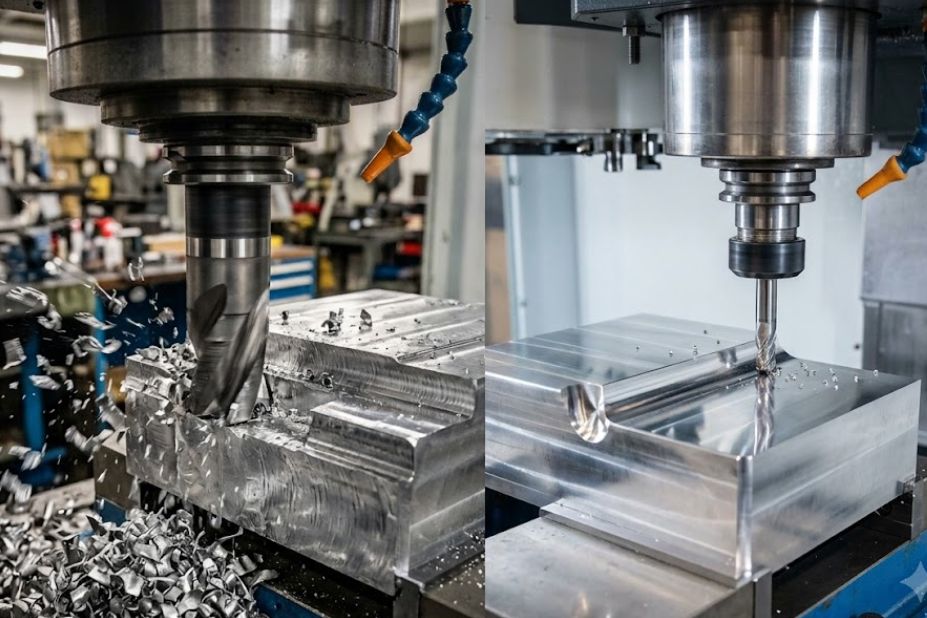
CNC milling can transform materials such as aluminium, plastics, timber and MDF into accurately shaped components, prototypes, panels and custom parts. Depending on the project, machining may involve pockets, profiles, contours, cavities, slots and detailed features.
However, achieving the required shape and finish does not usually require removing all the material in a single cut. CNC milling often uses a combination of roughing and finishing passes, with each stage serving a specific purpose.
Roughing focuses on removing unwanted material quickly and efficiently. Finishing follows, using lighter, more controlled cuts to achieve the required dimensions, geometry, and surface quality.
Understanding the difference between these operations can help explain why different cutters, feed rates, step-downs and step-overs are used during the machining process.
What Is Roughing in CNC Milling?
In simple terms, roughing is the initial material-removal stage. It removes most of the excess stock from the workpiece and brings it closer to its intended shape.
The objective is generally to achieve an efficient material removal rate without placing excessive stress on the cutting tool, machine or workpiece.
A typical roughing operation may involve:
- Clearing large areas of unwanted material
- Removing material from pockets and cavities
- Establishing the general profile of the component
- Machining deeper sections through several cutting levels
- Leaving a controlled amount of stock for finishing
Rather than attempting to reach the final dimensions immediately, the roughing toolpath intentionally leaves some material behind. This machining allowance provides the finishing operation with sufficient material to establish the final surface and dimensions.
CNC Roughing Tool Selection
CNC roughing tool selection depends on the material, geometry, machine capabilities, and the amount of material to be removed.
A roughing cutter generally needs to withstand higher cutting loads than a tool used for light finishing.
The choice may be influenced by:
- Material hardness and cutting characteristics
- Required cutting depth
- Pocket or profile geometry
- Cutter diameter
- Machine power and rigidity
- Required material removal rate
- Desired chip evacuation
A suitable roughing tool allows the machine to remove material efficiently while maintaining controlled cutting conditions.
What Is Finishing in CNC Milling?
Finishing is the machining stage used to bring selected surfaces and features closer to their final dimensions and required surface quality.
After roughing has removed most of the unwanted material, a finishing cutter takes lighter cuts through the remaining machining allowance.
Finishing can be particularly important where a component requires:
- Accurate final dimensions
- Precise mating or alignment surfaces
- Defined tolerances
- Smooth visible surfaces
- Detailed contours
- Cleaner edges and profiles
Unlike roughing, where productivity and material removal are major priorities, finishing places greater emphasis on consistency, dimensional control and surface appearance.
A lighter cut can also help reduce cutting forces and minimise deflection when machining delicate features or thin sections.
Roughing Pass vs Finishing Pass Explained
The simplest way to understand the difference is to consider the purpose of each operation.
A roughing pass removes material. A finishing pass refines what remains.
However, the distinction also affects tooling, feed rates, cutting depths and toolpath spacing.
Factor | Roughing Pass | Finishing Pass |
Primary purpose | Remove excess material | Achieve final geometry and surface quality |
Material removal | High | Lower |
Cutting depth | Generally larger | Generally lighter |
Step-over | Generally larger | Generally smaller |
Feed rate | Usually higher | More controlled |
Cutting load | Higher | Lower |
Tooling | Robust material-removal cutters | Tools selected for accuracy and finish |
Machining allowance | Leaves stock for later operations | Removes remaining allowance |
Surface quality | Primarily functional | Greater emphasis on final appearance and texture |
Dimensional control | Establishes approximate geometry | Brings features towards specified dimensions |
The exact values used during either operation are determined by the material, cutter, machine, workholding, geometry and required result.
How Do Step-Down and Step-Over Affect CNC Milling?
CNC milling step-down and step-over explained start with two important toolpath parameters.
Step-Down
Step-down refers to the vertical distance the cutter moves into the material between successive cutting levels.
A larger step-down can remove more material per pass, which can improve productivity. However, it can also increase cutting forces and tool loading.
During finishing, a smaller step-down may be used where the geometry or machine setup requires greater control.
Step-Over
Step-over refers to the horizontal distance between adjacent toolpath passes.
A larger step-over can cover an area more quickly during roughing. A smaller step-over places the toolpaths closer together, which can reduce the remaining ridges or cusps on a finished surface.
This makes step-over particularly relevant when a smooth surface is required.
The appropriate values are not universal. They need to be selected according to the cutter, material, machine, geometry and required finish.
How Do Roughing and Finishing Affect Surface Quality?
Roughing establishes the basic geometry, but the condition of the workpiece after roughing can influence the quality of the final finishing operation.
Ideally, roughing should leave a reasonably consistent amount of material for the finishing cutter to remove. Uneven stock can result in changing cutting loads and may affect consistency.
Other factors can influence the surface finish quality after the CNC finishing pass, including:
- Tool wear
- Cutter geometry
- Feed rate
- Spindle speed
- Step-over
- Cutting depth
- Machine rigidity
- Workholding
- Material characteristics
- Vibration or chatter
- Toolpath strategy
A worn cutter, for example, can leave unwanted marks, while vibration may produce visible patterns or waviness across the machined surface.
CNC Milling Surface Roughness Ra Values
CNC milling surface roughness Ra values describe the average surface profile deviation measured over a specified sampling length. Ra is commonly expressed in micrometres (µm).
There is no single Ra value that every CNC-milled component must achieve. The required value depends on the purpose of the surface and the specification for the part.
The desired Ra value should therefore be established from the engineering drawing, project specification or customer’s requirements rather than assuming that a particular value applies to every CNC milling job.
How Many Passes Does CNC Milling Need?
The number of passes depends on how much material must be removed and what the finished component needs to achieve.
Factors include:
- Material thickness: Greater depths may require multiple cutting levels.
- Part geometry: Complex pockets and contours can require several toolpaths.
- Material type: Aluminium, plastics, MDF and timber behave differently during cutting.
- Tolerance requirements: Tighter dimensions may require additional machining and inspection.
- Surface finish: A finer finish can require closer toolpaths or an additional finishing operation.
- Tool diameter: Smaller cutters may require more passes to cover an area.
- Machine capability: Machine rigidity and available power can influence cutting parameters.
- Workholding: Delicate or thin components may require lighter cutting conditions.
A job may use roughing followed by finishing, while a more demanding component may also require a semi-finishing operation.
What Are Roughing and Finishing Feed Rates?
Roughing feed rates vs finishing feed rates can differ because the two operations have different priorities.
During roughing, the machine is generally focused on removing material efficiently. This can involve a higher feed rate, depending on the capabilities of the machine, cutter, and material.
During finishing, the feed rate may be adjusted to provide greater control over the final surface and dimensions.
How Does Roughing and Finishing Affect Machining Time and Cost?
Both roughing and finishing contribute to the total CNC machining cycle.
The time difference between roughing and finishing CNC, therefore, varies from job to job.
A simple component may require relatively little finishing, while a complex three-dimensional component can spend considerable time in the finishing stage.
Factor | Effect on Roughing | Effect on Finishing |
Material volume | Can substantially increase machining time | Usually less significant after bulk stock is removed |
Part complexity | May require additional clearing | Can create detailed, longer toolpaths |
Step-over | Larger values can reduce cutting time | Smaller values can increase cycle time |
Feed rate | Often selected for efficient stock removal | Adjusted for controlled machining |
Tool wear | Can increase with heavy material removal | Can affect accuracy and surface quality |
Tolerances | Less critical during bulk removal | Can require additional passes or inspection |
Surface requirements | Usually secondary | Can significantly affect cycle time |
There is therefore a balance between machining speed, tool life, dimensional accuracy and surface quality.
When Is a Semi-Finishing Pass Useful?
Some components benefit from an operation between roughing and final finishing.
A semi-finishing pass can remove uneven remaining stock and establish a more consistent surface for the final cutter. This can be useful for complex contours, deep pockets and components where the finishing tool needs to operate under controlled cutting conditions.
For example, a machining strategy could involve:
- Roughing to remove the majority of the material.
- Semi-finishing to even out the remaining stock.
- Finishing to achieve the specified geometry and surface quality.
Not every component requires all three stages. The machining strategy should be based on the requirements of the individual part.
Plan Your CNC Milling Project with Just Routing
The right balance between roughing and finishing depends on the material, geometry, tolerances, surface requirements and intended application. Selecting suitable tools and machining parameters at each stage can help achieve the required result without adding unnecessary operations.
Just Routing provides CNC milling services for projects requiring accurate machining and detailed component production. The team works with materials including timber, MDF, plastics and metals, supporting projects ranging from prototypes and one-off components to larger production requirements.
Whether you need a simple profile, detailed contour, pocket, or custom-machined component, discuss your project requirements with Just Routing to determine the most suitable CNC milling approach.
FAQs
Is roughing always required before CNC finishing?
No. A separate roughing operation is not necessarily required for every job. If the starting material is already close to the required shape or only a small amount of material needs to be removed, finishing may be sufficient.
What is the main difference between roughing and finishing?
Roughing primarily focuses on removing excess material efficiently, while finishing focuses on achieving the required final dimensions, geometry and surface quality.
Can a smaller step-over improve CNC surface finish?
A smaller step-over can reduce the height of remaining cusps between adjacent toolpaths, potentially improving the machined surface. However, it also increases the number of toolpath movements and can increase machining time. Yes, CNC machining maintains consistent accuracy across large production runs because the machine repeats identical programmed movements every cycle. This repeatability helps manufacturers produce uniform parts with minimal dimensional variation or quality inconsistencies.
What affects CNC milling surface roughness?
Surface roughness can be influenced by cutter selection, tool condition, feed rate, spindle speed, step-over, cutting depth, machine rigidity, vibration, workholding and the characteristics of the material.
Does a finishing pass always produce a smooth surface?
Not necessarily. The final result depends on the selected tooling, cutting parameters, machine condition, workholding, material and toolpath strategy. A finishing pass is intended to improve control over the final surface, but the required result must be specified and verified for the individual component.
How many passes are needed to mill a part?
There is no fixed number. The required passes depend on the amount of material, part geometry, material type, cutter selection, machining parameters, tolerances and required surface finish.
Table of Contents
- What Is Roughing in CNC Milling?
- What Is Finishing in CNC Milling?
- Roughing Pass vs Finishing Pass Explained
- How Do Step-Down and Step-Over Affect CNC Milling?
- How Does Roughing and Finishing Affect Surface Quality?
- How Many Passes Does CNC Milling Need?
- What Are Roughing and Finishing Feed Rates?
- How Does Roughing and Finishing Affect Machining Time and Cost?
- Plan Your CNC Milling Project with Just Routing
- FAQs
