
MDF vs Plywood vs Timber: Which is the Best Material for CNC Cutting?
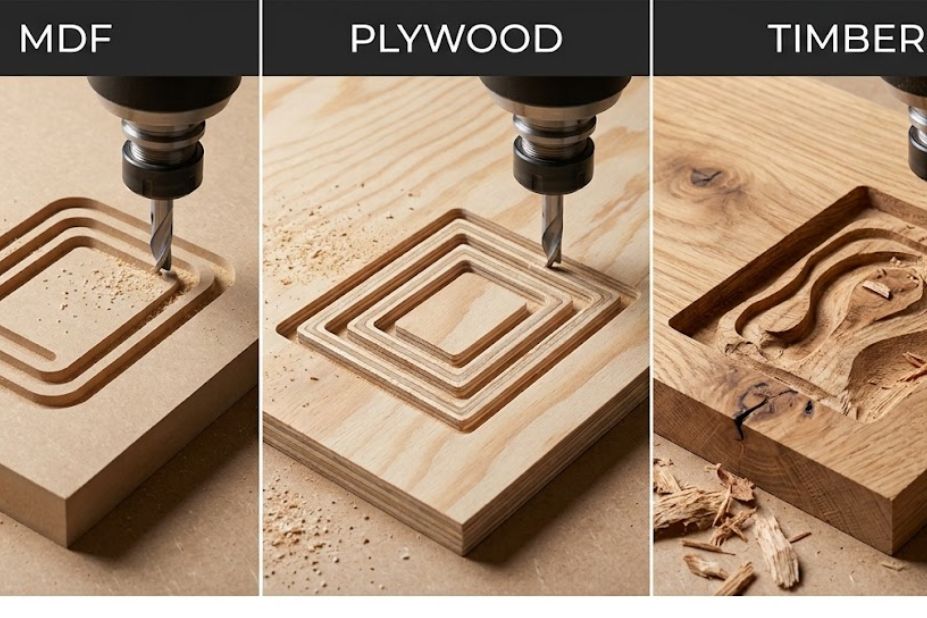
Choosing between MDF, plywood and solid timber for CNC cutting depends on the final application, required strength, finish and budget. If you are asking “Is MDF good for CNC cutting?”, the answer is yes, especially for detailed routing, painted cabinetry and smooth, consistent profiles.
Plywood is generally better for strength and screw holding, while solid timber is ideal when natural appearance is a priority. The best CNC material is the one that matches the design, environment, and expected performance of the finished component.
Is MDF Good for CNC Cutting?
MDF, or medium-density fibreboard, is one of the most commonly used engineered wood products for CNC routing, particularly when a project needs smooth surfaces, detailed profiles and repeatable machining.
Its relatively uniform structure means a CNC router can follow complex toolpaths without encountering the changes in density commonly found in solid wood.
Australian supplier DMK Forest Products recommends standard MDF for applications including detailed joinery, lacquered furniture, mouldings, built-in furniture, shelving and wall linings.
Why Does MDF Work Well with CNC Routers?
MDF is particularly useful for:
- Routed cabinet doors
- Decorative wall panels
- Signage
- Furniture components
- Display panels
- Interior joinery
- Recessed patterns and lettering
- Prototype components
What Are the Limitations of CNC Cutting MDF?
Cutting and especially sanding wood products generate fine dust, making effective dust extraction and workplace controls important. Safe Work Australia research reports that sanding MDF can generate more airborne dust than sanding some other timber products. However, research cited in the same report found no significant difference in dust quantity when MDF was cut compared with softwood, hardwood and other reconstituted fibreboard.
How Does MDF Compare with Plywood for Strength?
In an MDF vs plywood strength comparison, plywood is generally the preferred material when structural strength, stiffness and fastener performance are important.
Plywood is manufactured from multiple veneers with their grain directions typically arranged across adjacent layers. This cross-laminated construction provides useful strength and dimensional characteristics. The Engineered Wood Products Association of Australia‘s structural plywood design information lists different stress grades, from F4 through to F34, with characteristic engineering properties varying according to grade.
MDF vs Plywood at a Glance
Factor | MDF | Plywood |
Surface consistency | Excellent | Good |
Detailed CNC routing | Excellent | Very good |
Structural strength | Lower | Generally higher |
Painted finish | Excellent | Requires more preparation |
Visible edge appearance | Plain fibre edge | Layered decorative edge |
Screw holding | Moderate | Generally better |
Moisture options | MR grades available | Exterior/moisture-resistant grades available |
Splintering risk | Low | Higher without correct tooling |
What is the Best Wood Sheet Material for CNC Routing?
There is no single material that is best for every CNC project. The most suitable option depends on the finished component and how it will be used.
When Should You Choose MDF?
Choose MDF when you need:
- Intricate routed patterns
- Consistent machining
- Smooth painted surfaces
- Cabinet doors
- Decorative panels
- Cost-effective interior components
When Should You Choose Plywood?
Plywood is often the better option for:
- Furniture requiring greater strength
- Cabinet carcasses
- Shelving
- Components that need a reliable fastener holding
- Visible layered edges
- Projects exposed to greater handling or mechanical loads
Do MDF Blunt CNC Router Bits Go Faster?
MDF can be demanding on cutting tools. Its manufactured structure contains compressed wood fibres and binders, and continuous production routing can gradually reduce cutting-edge sharpness. The actual rate of tool wear depends on the MDF product, cutter material, feed rate, spindle speed, cutting depth and production volume.
How Can Plywood Be CNC Cut Without Splintering?
CNC cutting plywood without splintering requires the right combination of material quality, cutter geometry, tool condition and machining strategy. Because plywood consists of veneers, the outer face can chip or tear if fibres are pulled upward during cutting.
What are the Challenges of Solid Timber CNC Machining?
Every board is different. Grain direction, knots, density and moisture content can change how the cutter interacts with the material.
Why Does Grain Direction Matter?
Wood fibres have a natural orientation. Depending on how a cutter approaches those fibres, machining can produce clean surfaces or tear-out. Complex profiles may involve cutting both with and against the grain during the same operation.
Other CNC Challenges with Solid Timber
Operators may also need to manage:
- Knots and resin pockets
- Internal stresses
- Board movement
- Moisture variation
- Inconsistent density
- Warping or cupping
- Tear-out around detailed profiles
What MDF Sheet Sizes are Available for CNC Cutting in Australia?
As one example of an Australian supplier, DMK Forest Products lists standard MDF in sizes including 2400 × 1200 mm and 2440 × 1220 mm, with selected products also available in longer 3600 mm or 3660 mm sheets. Listed thicknesses range from thin 3 mm panels through to 32 mm boards, depending on sheet dimensions.
Is MDF or Plywood More Moisture Resistant?
The moisture resistance of MDF vs. plywood cannot be determined solely by the material name, as both products are manufactured in different grades.
Standard MDF is primarily suited to dry interior applications. DMK Forest Products, for example, describes its raw standard MDF as an interior product. The same supplier separately stocks MR, or moisture-resistant, MDF products.
How Does the CNC Material Cost of MDF and Plywood Compare?
A CNC material cost comparison of MDF vs plywood should consider more than the purchase price of a sheet. MDF is often a cost-effective option for interior CNC projects, particularly where components will ultimately be painted. Plywood can have a higher initial material cost depending on species, face grade, structural rating and construction.
Which Material is Better for Cabinet-making CNC?
Different sections of the same cabinet can benefit from different substrates.
Why is MDF Popular for Cabinet Doors?
MDF is particularly suitable for routed cabinet doors because intricate profiles can be machined into its uniform surface.
It is frequently selected for:
- Shaker-style doors
- Routed door profiles
- Painted panels
- Decorative fronts
- Feature cabinetry
Why is Plywood Useful for Cabinet Construction?
Plywood can be advantageous where the design requires greater stiffness or fastener holding.
It may be used for:
- Cabinet carcasses
- Shelving
- Furniture frames
- Structural panels
- Exposed-edge contemporary cabinetry
Get the Best Results with Just Routing’s CNC Cutting
At Just Routing, we provide CNC routing, cut-to-size panel services, custom door routing, flat-pack and assembly services, and CNC milling solutions. With more than 20 years of experience, we use modern CNC technology to produce accurately machined components for projects across Brisbane, the Gold Coast, and the Sunshine Coast.
Whether your project requires MDF cabinet doors, plywood components or precision-machined timber, we can help match the machining process to your project’s specifications. Contact us to discuss your CNC cutting requirements and find the right material and machining solution for your next project.
FAQs
What is the difference between MDF, plywood, and timber for CNC projects?
MDF offers consistent, smooth machining, plywood provides greater strength and fastener holding, while solid timber delivers natural character. Timber’s grain and knots can make CNC machining less predictable than engineered sheet materials.
Which router bits work best for cutting MDF, plywood, and timber?
Carbide spiral bits work well for MDF and timber, while compression bits are commonly preferred for plywood to minimise chipping on both faces. The ideal cutter depends on material, thickness and required finish.
Does CNC routing MDF create more dust than plywood or timber?
MDF produces significant fine dust during CNC machining. However, dust levels vary by operation and material, so effective extraction and appropriate workplace controls are important when routing MDF, plywood or timber.
What sheet thickness gives the most accurate CNC cutting results?
Results depend on material flatness, tooling, machine setup, work holding and cutting parameters. Sheet thickness should primarily be selected according to the component’s design and performance requirements.
Which material - MDF, plywood, or timber - takes paint and laminate finishes best?
MDF is generally excellent for painted finishes because of its smooth, consistent surface. MDF and suitable plywood can accept laminates effectively, while solid timber is often preferred when natural grain remains visible.
Can solid timber be CNC machined as precisely as sheet materials like MDF and plywood?
Yes. Solid timber can be CNC machined precisely, but grain, knots, moisture and density variations require careful material selection, secure workholding, appropriate toolpaths and sharp cutters to achieve consistently accurate results.
Where can I get MDF, plywood, or timber CNC cut near me in Australia?
Just Routing provides CNC routing and machining services in South East Queensland, including Brisbane, the Gold Coast, and the Sunshine Coast. Contact our team to confirm your material, dimensions and specific CNC cutting requirements.
Table of Contents
- Is MDF Good for CNC Cutting?
- How Does MDF Compare with Plywood for Strength?
- What is the Best Wood Sheet Material for CNC Routing?
- How Can Plywood Be CNC Cut Without Splintering?
- What are the Challenges of Solid Timber CNC Machining?
- What MDF Sheet Sizes are Available for CNC Cutting in Australia?
- Is MDF or Plywood More Moisture Resistant?
- How Does the CNC Material Cost of MDF and Plywood Compare?
- Which Material is Better for Cabinet Making CNC?
- Get the Best Results with Just Routing’s CNC Cutting
- FAQs
